

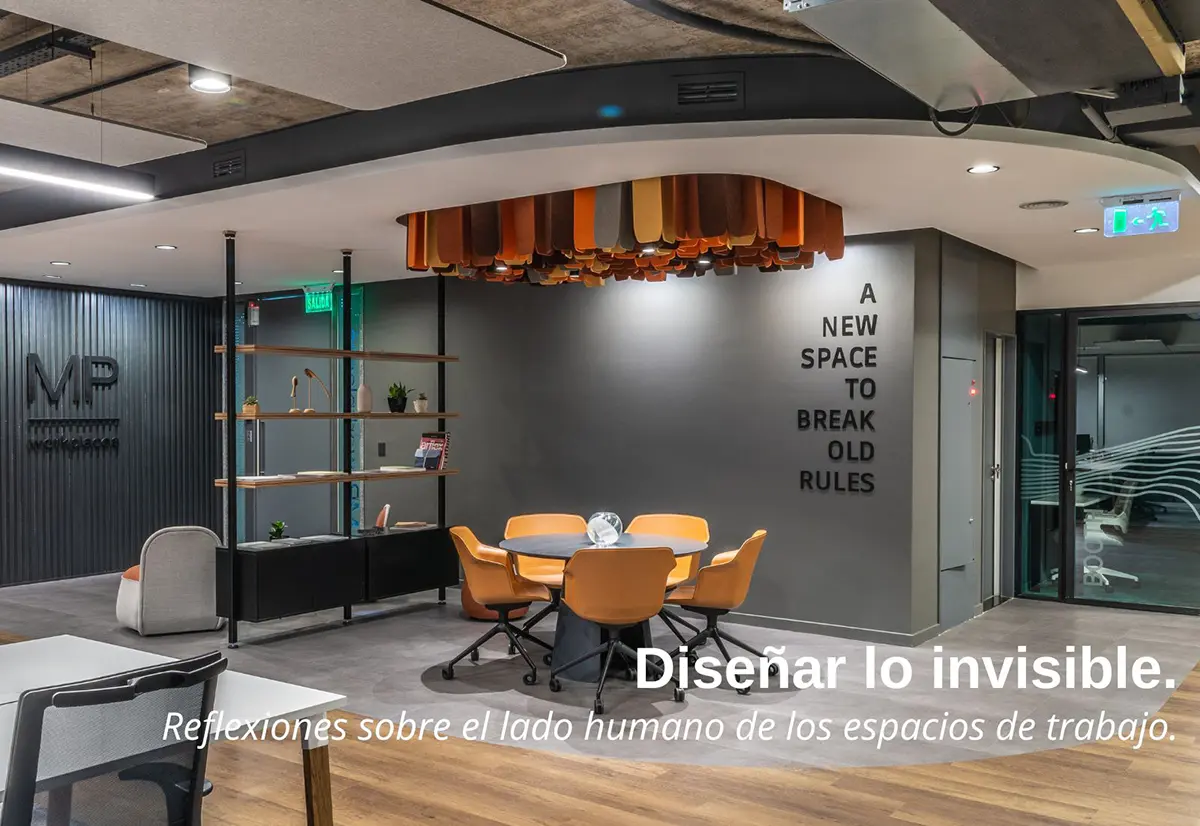
Designing the invisible. Reflections on the human side of workspaces.
I have spent more than 25 years working alongside companies to design their workspaces.
In that time I have learned that offices are the places where people spend a significant part of their lives generating ideas, building relationships and making decisions, but above all, they are where an organization's culture develops.
Over time, I also came to understand that designing these spaces carries an enormous responsibility. Every decision we make can influence the way people work, collaborate, concentrate, learn and experience their everyday lives.
I decided to start a series of posts to share experiences, lessons and ideas I have built up over the course of my career, which show us that office design has aspects that are not always visible.
Welcome to Designing the Invisible. Reflections on the human side of workspaces.
Reflection #1 | Offices with a purpose
What if the true value of an office were not in the space itself, but in everything it makes possible?
An organization's purpose isn't conveyed in a presentation or on a poster with its mission and values. It is conveyed day to day: in how people collaborate, learn from one another, share ideas, welcome a client or show empathy for a colleague.
It is in those small everyday moments that culture stops being a concept and becomes an experience. Perhaps that is one of the biggest transformations of the workplace in recent times.
I believe an office should be a space designed to foster connection, learning, well-being and a sense of belonging. Not because the workplace is the protagonist, but because the people are.
At MP Workplaces, we are convinced that design, on its own, does not create culture. But it does have the power to strengthen it or to make it harder for it to express itself.
People choose to work in the office when they feel that the workplace lets them connect with others, grow professionally and be part of something bigger than their daily tasks.
Because it is not spaces that transform organizations, but the people who inhabit them.
Reflection #2 | Spaces that evolve
What if one of the main qualities of a workspace were its ability to evolve along with the organization?
Organizations change all the time. They bring in new people, develop different ways of working, adopt new technologies and face challenges that often didn't exist when their offices were designed.
That is why it is hard today to think of design as a final answer. Increasingly, a good project is one that meets present needs but also paves the way for the future.
Every project starts with listening. Understanding the organization's culture, its goals, the way it works and the needs driving the change.
But an equally important part of our work is helping our clients look a little further ahead. To explore how their teams might evolve, what new ways of working might emerge and how the space can support them.
That is why, when we talk about flexibility, we don't think only of modular furniture or construction solutions. We think of design decisions that allow the workplace to evolve intelligently, preserving what gives it its identity and avoiding having to start from scratch with every change.
At MP Workplaces, we understand that when a project ends, a new stage begins: that of a space that will accompany an organization's growth for many years.
And the spaces that stand the test of time are the ones prepared to evolve along with their organizations.
Reflection #3 | The intelligence behind the space
What if true innovation in workspaces were not found in technology alone, but in our ability to better understand people?
Workspaces have been going through many transformations in recent years.
The adoption of artificial intelligence and new digital tools opens up possibilities that until recently seemed far off: analyzing information, identifying patterns, better understanding how spaces are used and discovering new opportunities to design environments more closely aligned with the needs of the people who use them.
But the real value appears when technology is integrated with professional experience, listening and a deep knowledge of each organization.
Data can help us understand how areas are used, which dynamics encourage collaboration, where opportunities for improvement arise and how to support an organization's evolution. It can even give us valuable information related to the company's corporate image.
But turning that information into design decisions requires judgment, sensitivity and an understanding of people.
At MP Workplaces, we believe the future of the workplace lies in the integration of technology, design and a human perspective. Artificial intelligence does not replace the intelligence of design. It amplifies it.
Because it isn't about creating smarter offices by adding more technology. It is about creating spaces capable of learning, adapting and evolving together with the people who inhabit them.
My conclusion is that the technology that adds value when we design is the kind that shows up in people's experience.
Reflection #4 | The Value of Silence
What if the true luxury of an office were no longer a prime view, but the ability to concentrate?
For a long time, office design was associated with aesthetics, technology or the quality of the furniture. And of course, all of that is important.
But it is equally key to a good work environment that we design spaces where people can carry out their daily tasks better.
Sometimes it is very hard to find moments of true concentration when we are surrounded by people. Calls, constant notifications and conversations are always competing for our attention. And in that context, the workplace can become an obstacle... or a great ally.
I am sure that it is not about going back to closed offices or compartmentalized workstations, but about designing environments that allow people to collaborate when needed, but also to analyze, think or create without interruptions.
Fortunately, there are now solutions that help us create quieter spaces: a wide variety of sound-absorbing materials, booths for calls or video conferences, special furniture with acoustic treatment, and various technologies that significantly reduce disruptive office noise.
The reality is that none of these resources will make an office provide the right conditions unless specialized professionals think about how to integrate them so that they become a real solution.
At MP Workplaces, every project reaffirms that acoustic treatment is not a technical detail, but a design decision that directly affects well-being.
And I am convinced that designing spaces where people can concentrate is one more way of caring for them.
Reflection #5 | The Light That Accompanies
What if lighting had a much greater influence on how we feel than we imagine?
What if lighting influenced how we feel much more than we imagine?
Most people only think about lighting when it is insufficient. Yet few design decisions have such a constant, quiet impact on the workplace experience.
Natural light affects our well-being, our concentration, our perception of the passing of time and even the level of energy with which we get through the day.
I remember that for many years it was common to reserve the best views and glass façades for private offices. Paradoxically, the people who used those spaces were executives who spent little time in the office.
Then we realized it was a mistake, since those assets can create much more value when they benefit the people who use the workplace every day.
In the projects we develop at MP Workplaces, one of the first design decisions is to prioritize giving as many workstations as possible access to natural light.
We know that artificial lighting is a fundamental component, and there are increasingly efficient and intelligent solutions to support the different moments of the day.
Nevertheless, no technology can replace the value of a design that, from the start, takes advantage of the natural conditions of the site.
Because good lighting isn't only about seeing better. It helps us work better.
And treating it as a design premise is a decision that improves people's experience.
Reflection #6 | The identity one inhabits
What if an office's identity were not in the logo at reception, but in what the workplace communicates without saying a word?
For a long time, we understood branding as the application of corporate colors, logos, institutional slogans or graphic elements.
However, an organization's identity isn't built through its image alone. It is built, above all, through the experience people have when they inhabit that space.
Long before a meeting begins, a workplace has already started to communicate.
The way a company welcomes people, which areas it prioritizes, how it makes everyday work easier or what kinds of relationships it encourages communicates as much as, or more than, any visual identity manual.
That is why branding has stopped being only a communication tool and has also become a design tool. Today we talk about spatial branding because we understand that a brand isn't only seen. It is also experienced.
At MP Workplaces, we believe an office doesn't represent a company's identity through the number of logos it displays, but through the consistency between what the organization says and what people experience every day.
Every design decision (the materials, the lighting, the signage, the furniture, the way people move through the workplace and even the way they interact with one another) helps build an experience that is consistent with an organization's culture.
Because a brand is built, and gains its identity, in the everyday experience of those who inhabit it.
Reflection #7 | What space makes possible
What if the true value of collaborative spaces were not in what they offer, but in what they allow to happen?
I remember a time when designing a collaborative office meant adding more informal areas, open meeting spaces or a café with varied furniture.
Today we can say with certainty that having all of those spaces does not guarantee that collaboration will happen.
Collaboration happens between people when they talk, share knowledge, solve things together or discover an idea from an exchange that perhaps wasn't planned.
I believe one of the most interesting transformations of the workplace was to stop thinking only about the efficiency of the layout and start asking ourselves what that space can make possible.
The strategic placement of teams, meeting points and even everyday walking routes can create opportunities for people to cross paths, talk and share what they know.
On the other hand, encouraging those exchanges doesn't mean promoting constant interaction, since we also need time to concentrate and work individually.
The challenge is to make both situations coexist and to give people the option to choose how and where to work depending on what they need to do.
At MP Workplaces, we know that design doesn't generate collaboration by itself, but it can create conditions for people to meet naturally, share knowledge and build relationships.
A well-designed workspace creates the conditions for things to happen that can't be planned.
Reflection #8 | The nature we need
What if bringing nature into workspaces were much more than adding plants?
When we talk about biophilia in an office, it's easy to think first of the presence of greenery.
But biophilia proposes a much deeper perspective: it starts from something as essential as our need to stay in contact with nature, including in the places where we work.
Natural light that changes throughout the day, natural materials and textures, or the possibility of noticing changes in the surroundings are different ways of bringing nature closer to the workspace.
But what matters most is what that connection can bring about in people. Contact with natural elements can help reduce stress, promote well-being and help restore attention after periods of concentration.
In a day filled with screens, meetings, conversations and constant stimuli, keeping some link with nature can offer us small moments of pause and recovery.
This perspective shapes very concrete decisions in a project: how we lay out the spaces to promote access to natural light, which views we seek to preserve, how we connect the interior with the exterior or which materials we choose to build an atmosphere closer to nature.
Biophilic design isn't about adding a few of these elements at the end of a project, but about integrating this perspective from the very beginning, understanding that what we design also influences how people feel and how they inhabit the place where they work.
At MP Workplaces, we understand biophilia as a design decision that contributes to well-being and helps us create more human workspaces.
Because perhaps designing more human spaces also means something as essential as not losing our connection with nature.
Final Reflection
When we founded MP Workplaces 17 years ago, offices were designed more for the outside than for the inside. I remember that many companies invested especially in the design of their spaces when they received clients and needed to convey a strong corporate image.
In the articles I shared throughout this series, I chose instead to talk about aspects of design that aren't always visible at first glance when we show a finished project.
I talked to you about silence and concentration. About natural light and spatial quality. About culture, technology and identity. About encounters, biophilia and everything a well-designed space can make possible.
Different topics that nevertheless have a common denominator: people.
Because behind every design decision there is someone who will work, meet others, concentrate, learn, create and share a good part of their days in that place.
Looking at this whole journey from that perspective also led me to revisit the purpose that has represented us all these years:
“We are an architecture services company made up of professionals committed to the needs and resources of our clients.”
Today I believe that purpose could be expressed in a way that represents us better:
“We are specialists in designing workspaces that empower people, because they are the ones who transform organizations.”
Perhaps this is the true conclusion of these reflections.
Or perhaps it is a new beginning.
Ana MorenoCommercial Director